The History of the EMF Meter in Ghost Hunting
How an Electrician's Tool Became Ghost Hunting’s Secret Weapon
There is no piece of equipment more iconic in modern ghost hunting than the EMF detector.
Whether you’ve watched late-night ghost hunting television shows or joined a midnight lantern tour through an abandoned asylum, you’ve almost certainly seen it: an investigator holding a small device into the dark, watching a row of colored LED lights flash from green to bright red as an unseen energy draws close.
While it feels tailor-made for detecting spirits, the EMF meter didn't start in the world of the supernatural. It was born out of 19th-century industrial physics.
From Industrial Safety to Supernatural Discovery: The Evolution of EMF
An Electromagnetic Field (EMF) meter is engineered to measure invisible environmental forces—specifically AC (alternating current) and DC (direct current) electromagnetic radiation emitted by electrical currents and magnetic fields.
The scientific foundation for EMF measurement was laid in the mid-1800s by physicists like Michael Faraday and James Clerk Maxwell, who proved that electricity and magnetism were inextricably linked. By the mid-20th century, handheld EMF detectors were mass-produced for industrial trade workers. Electricians used them to locate hidden wiring behind plaster, pinpoint power line leakage, and protect technicians from dangerous radiation near high-voltage machinery.
So how did an industrial safety tool become a staple of ghost hunting?
The 1970s Shift in Paranormal Research
In the late 1970s and 1980s, parapsychologists and early field investigators began bringing industrial measurement tools into locations with reported hauntings. They noticed a striking pattern: rooms with intense reported activity—disembodied voices, cold spots, or moving objects—frequently exhibited inexplicable, localized spikes in electromagnetic energy that had no physical or electrical source.
This led to the foundational theory that underpins modern ghost hunting today.
Why Ghost Hunters Use EMF Meters: The Dual Theory
Modern investigators rely on EMF detectors for two very different—yet equally important—reasons during a sweep:
1. Tracking Entity Energy
The leading theory in field research suggests that entities, lacking physical bodies, consist of or manipulate raw ambient energy. When a spirit attempts to manifest, move across a room, or interact with investigators, it draws upon or projects a localized electromagnetic charge. An anomalous spike on a meter—especially one that moves or responds to direct questions—acts as a real-time visual "footprint" of an unseen presence.
2. Ruling Out "Fear Cages" and Hallucinations
Not every EMF spike is a ghost—and that’s vital for a scientific investigation. High levels of unshielded electrical radiation (from old fuse boxes, loose wiring, or heavy appliances) create what investigators call a "Fear Cage."
Prolonged exposure to high, artificial EMF can trigger genuine physical reactions in humans:
- Unexplained anxiety or paranoia
- Dizziness and nausea
- A "skin-crawling" sensation
- Visual or auditory hallucinations
Investigators use EMF meters first to map out these artificial sources so they can rule out false positives and ensure guests aren't just reacting to bad wiring.
How Ghost Hunters Across America Use EMF Meters Today
Across the United States, from historic battlefields to haunted bed-and-breakfasts, ghost hunters deploy EMF meters in a variety of creative, highly interactive ways:
- Interactive "Yes/No" Communication: In locations like the Lizzie Borden House in Massachusetts or the Villisca Axe Murder House in Iowa, investigators place meters near trigger objects (like toys or brass bells) and ask spirits to step toward the device to light up the LEDs for "Yes" and stay back for "No".
- Mapping Hotspots on Historic Tours: On walking tours through historic districts—like St. Augustine, Florida, or New Orleans' French Quarter—guides use sweeping EMF passes to show guests where energy clusters near ancient stone walls or old cemeteries.
- Correlating Multi-Tool Evidence: Experienced teams place EMF meters right next to voice recorders (EVP players) or thermal cameras. When an EMF spike occurs at the exact same second a voice is captured on audio, the evidence becomes significantly more compelling.
Field Partner Spotlight: The Specter Detector by US Ghost Adventures
When you’re investigating in pitch-black, highly active historic sites, standard industrial meters—with their tiny numeric screens and complex sub-menus—can be frustrating to read. You need a device engineered specifically for the realities of night investigations.
Enter the Specter Detector, designed from the ground up by the expert team at US Ghost Adventures and available through Ghost Daddy.

Purpose-Built for All-Night Stakes
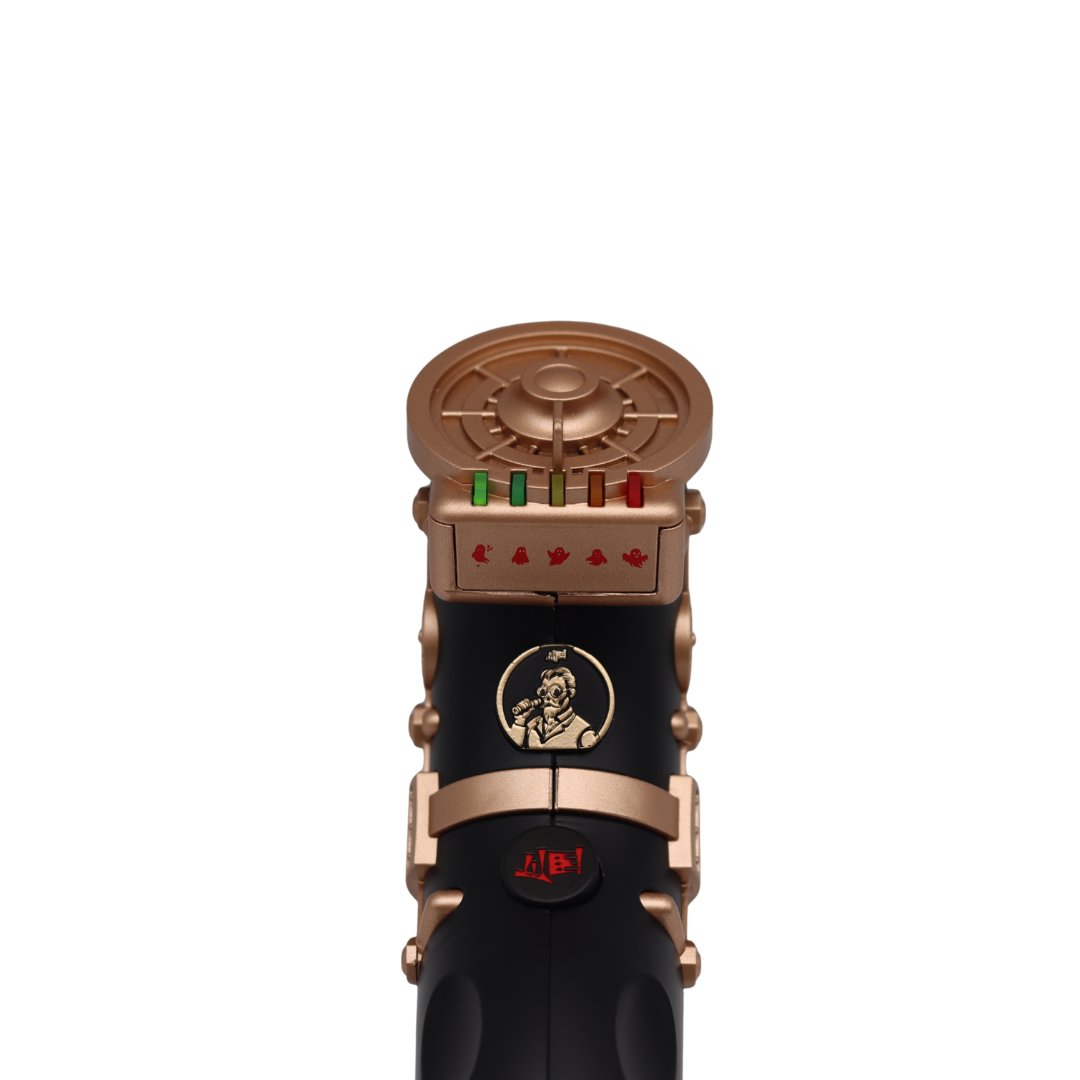
- Expressive Visual Readout: Instead of trying to squint at tiny numbers in the dark, the Specter Detector features a multi-colored LED array paired with five uniquely expressive red ghost icons that light up sequentially as energy builds, letting your entire team watch activity from across the room.
- Contoured Non-Slip Grip: Features a deeply contoured, ribbed handle with a matte finish so you won't drop it if a sudden jump-scare catches you off guard.
- USB-C Rechargeable Power: Powered by an internal 600mAh Li-Po battery delivering up to 24 hours of continuous operation. Its dual-bead system includes a dedicated blue LED that flashes when power hits 20%, ensuring you never unexpectedly lose your primary meter in the dark.
- Extended Radar-Dish Head: Designed with a specialized sensor head so you can easily sweep corners, under furniture, and around historic artifacts in an "S" pattern to isolate exact anomalous locations.
Final Thoughts
The EMF detector’s journey from an electrician's tool belt to the frontline of paranormal research proves how science and the supernatural often intersect. Whether you’re establishing a quiet baseline in a historic home or tracking an interactive energy spike across a dark room, having a dedicated tool like the Specter Detector turns invisible atmospheric shifts into clear, undeniable evidence.