Ghost Hunting Meets Victorian History: The Brickhouse Inn EMF Call Bell for Yes/No Evidence
If you’ve ever sat in the dark during an investigation, watching a digital screen or straining your ears through radio static, you know the frustration. Modern ghost hunting is packed with high-tech gadgets, but when it comes to getting clear, undeniable evidence, we often find ourselves coming full circle to the simplest method: the binary yes/no protocol.
To understand why a simple "yes" or "no" remains the gold standard of paranormal communication, you have to look back over 170 years. By combining Victorian séance tradition, 19th-century hospitality history, and modern electromagnetic sensors, today’s investigators are turning classic historical artifacts into some of the most reliable field gear available.
The Birth of the Binary Code
Long before digital meters and spirit boxes, paranormal research began with a remarkably simple code.
In 1848, the Fox sisters of Hydesville, New York, popularized "spirit rapping"—asking unseen entities to make physical knocking sounds to answer questions. They established a clear rule: one knock for yes, two knocks for no. This eliminated human guesswork and established the foundational protocol of Instrument Transcommunication (ITC).
By the late 1800s, Victorian mediums realized that spirits seemed to interact more readily with everyday, familiar objects. Parlors were filled with tabletop bells, slate boards, and spirit boards. These trigger objects gave entities a physical target, transforming invisible energy into immediate, acoustic evidence.
From Hotel Lobbies to Paranormal Parlors
While mediums were using bells in darkened parlors, a parallel revolution was happening in Victorian hospitality.
Before the mid-1800s, large estates relied on complex wire-and-pull bell systems to call servants. But as grand hotels, train stations, and public inns exploded across 19th-century America, front desks needed an instant signal. Metal foundries engineered the spring-loaded desktop "tap bell"—a cast-brass dome with a central plunger that delivered a sharp, resonant ring across a noisy lobby.
In historical hotspots like Gettysburg, Pennsylvania—and specifically famous locations like the historic Brickhouse Inn—the front-desk call bell became an everyday fixture. It symbolized arrival, presence, and direct human interaction.
Bridging History with Modern EMF Tech

Fast forward to modern investigations. Handheld EMF meters were an improvement, but watching a needle swing or an LED grid flicker forces you to stare at a plastic box instead of focusing on your location.
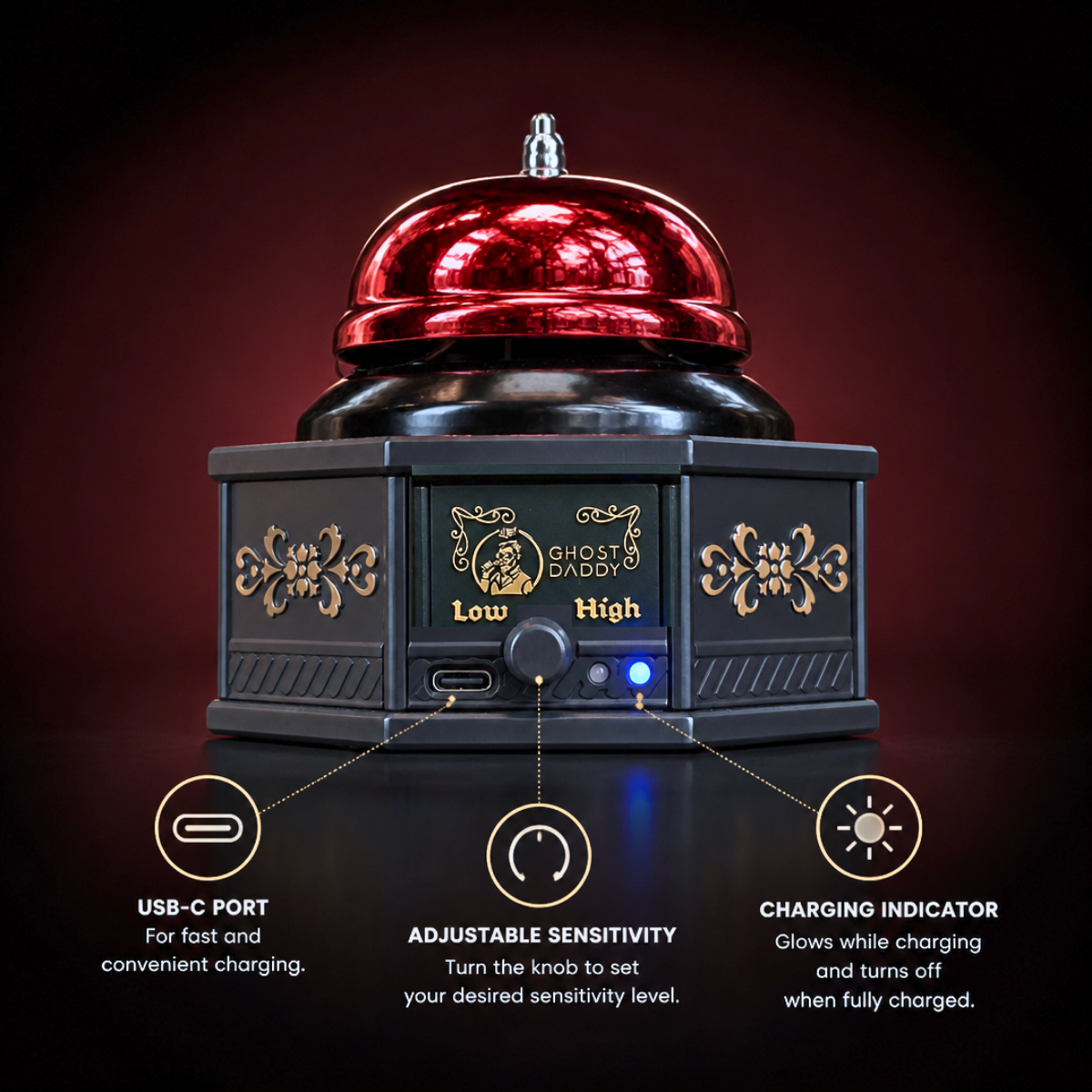
That’s where the Brickhouse Inn Call Bell EMF Detector by Ghost Daddy™ Gear comes in. Inspired by Gettysburg’s famously self-ringing historic desk bell, this device encloses advanced electromagnetic sensor hardware inside an authentic jet-black and gold Victorian replica.
Instead of digital static or blinking lights, the bell’s internal EMF sensor is linked directly to a physical bell hammer. The moment an environmental energy field shifts, it strikes the bell—delivering real-time audible chimes with zero digital lag or audio pareidolia.
Why It Belongs in Your Kit
- Physical Audible Feedback: Real-time bell rings trigger faster as energy surges, giving you unmistakable audio evidence on your voice recorders.
- Precision Baseline Calibration: A heavy-duty front control dial lets you manually tune out ambient electrical noise in high-baseline rooms or turn up sensitivity in dead zones.
- All-Night Battery Life: Powered by an internal 800mAh LiFePO4 battery that lasts up to 24 hours on a single charge—no more hunting for 9V batteries mid-lockdown.
-
Fast USB-C Charging & Telemetry: Recharges fully in 2 hours and 20 minutes, backed by clear LED indicators:
- 🔵 Flashing Blue: 20% Low battery warning
- 🔴/🟢 Flashing Red & Green: Active charging mode
- 🟢 Solid Green: Field-ready and fully charged
How to Run a Call Bell Investigation
- Set Your Baseline: Place the bell on a central wooden desk, table, or shelf where a historical desk bell naturally belongs. Turn the front control knob clockwise to power on, then slowly dial it back until the chime stops to lock in the room’s ambient baseline.
- Establish the Rules: Clearly state your ground rules to the room ("Ring the bell once for yes, twice for no").
- Document the Evidence: Let the physical bell do the talking while your audio and video recorders capture the real-time response.
Field-tested in high-activity locations like the Lizzie Borden House and the Villisca Axe Murder House, the Brickhouse Inn Call Bell proves that sometimes the best way to move paranormal research forward is by honoring where it all started.